Finite Element Flow

The Power of Predictive Engineering: A Guide to FEA
In the world of high-stakes engineering, “oops” is an incredibly expensive word.
Whether it’s a microscopic crack in a medical implant or a structural resonance issue in an offshore wind turbine, the gap between a perfect CAD model and real-world failure is often measured in millions of dollars, lost time, and damaged reputations. Traditionally, the only way to bridge that gap was through the “build-and-break” method, fabricating a physical prototype, pushing it until it snaps, and heading back to the drawing board.
Finite Element Analysis (FEA) changes that equation entirely.
The “Digital Safety Net”
At its core, FEA is a virtual stress test. It allows us to create a high-fidelity digital twin of your design and subject it to the chaotic forces of the real world – gravity, extreme heat, high-speed impacts, and cyclic vibrations – all before a single piece of metal is cut.
In 2026, the luxury of “over-engineering” a product – simply making it thicker and heavier to ensure it doesn’t break – is a relic of the past. With rising material costs and aggressive sustainability targets, the goal is no longer just to make a part that works; it’s to make a part that is optimised. FEA is the mathematical engine that allows us to find that “Goldilocks zone”, providing the perfect balance between minimum weight and maximum durability.
From Pretty Pictures to Precise Predictions
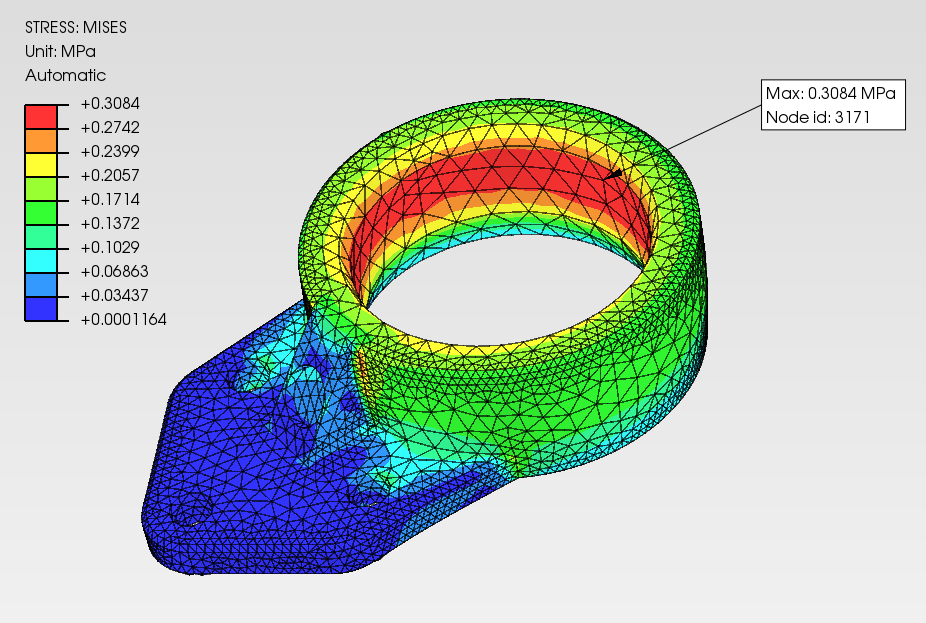
While many modern CAD packages include basic “push-button” simulation tools, true Finite Element Analysis is more than just generating colourful heat maps. It is a rigorous risk-management tool. By breaking down complex geometries into thousands of smaller, simpler “elements,” we can predict how a structure will likely deform, where the stress will concentrate, and precisely when it will fail.
It’s about moving from guesswork to certainty. In this guide, we’ll pull back the curtain on how FEA works, why the “mesh” matters more than you think, and how predictive modelling is helping our clients get to market faster with total confidence in their designs.
Step 1: The Mesh (The Foundation of Accuracy)
In Finite Element Analysis, we cannot simply tell a computer to “analyse this engine block.” The geometry is too complex for a single mathematical equation to describe. To solve this, we use a process called discretisation, more commonly known as Meshing.
Imagine taking a complex 3D object, like a car suspension arm, and wrapping it in a tightly woven net. Each “hole” in that net is a Finite Element, and the points where the lines intersect are Nodes.
Why the Mesh is the Most Critical Step
The mesh is essentially the “resolution” of your simulation.
- Coarse Mesh: Using large elements (a “low-resolution” net) allows the computer to solve the equations very quickly, but it misses the fine details. If a stress concentration is smaller than the element itself, the software simply won’t see it.
- Fine Mesh: Using hundreds of thousands of tiny elements provides incredible detail, but it requires massive computing power and time.
As a consultancy, our job is to find the Convergence Point. This is the mathematical “sweet spot” where making the mesh any finer no longer changes the results. If an analyst provides a report without a convergence study, they are essentially guessing at the accuracy of their own data.
Step 2: Material Intelligence (Defining Reality)
A mesh is just a shape; it has no physical “soul” until we define its material properties. This is where we bridge the gap between a digital drawing and a physical product.
We don’t just tell the solver that a part is “Steel.” We provide the specific physics of that material:
- Young’s Modulus: How stiff is it? (Does it spring back like a diving board or stay bent?)
- Poisson’s Ratio: When we stretch it, how much does it thin out in the middle?
- Yield Strength: At what exact point does the “stretch” become a permanent “break”?
For advanced projects, we go beyond simple metals. We simulate Non-linear Materials, such as polymers that have hyperelastic material properties, or composites that have different strengths depending on the direction the carbon fibres are laid. Metals, too, become non-linear when pushed into the realm of plasticity, a notoriously complex modelling domain.
Step 3: Boundary Conditions (The Real-World Context)
The final piece of the puzzle is to tell the software how the part is held and what forces are acting on it. These are known as Boundary Conditions.
In the real world, parts aren’t floating in a vacuum. They are bolted to frames, pressed by hydraulic cylinders, or vibrating due to an engine’s RPM. We apply:
- Constraints: Which parts are “fixed” in space? (e.g., the bolt holes on a wall bracket).
- Loads: Where is the pressure coming from? Is it a steady weight (Static) or a sudden impact (Dynamic)?
The Expert’s Touch: This is the most common place for simulations to fail. If you constrain a part too rigidly in the simulation, it will appear much stiffer than it is in reality. Our role is to ensure the digital environment perfectly mimics the real-world physics.
When to Deploy FEA: Choosing the Right Tool for the Job
FEA is not a “one-size-fits-all” calculation. Depending on your product’s environment, we deploy different types of solvers to ensure the simulation matches reality. Here are the primary ways we use FEA to qualify your designs:
1. Static Analysis: The Foundation of Integrity
This is the most common application of FEA. We use it to determine if a part can handle a specific, constant load without failing or deforming excessively.
- Linear Static: Used for metals under small loads where the material returns to its original shape.
- Non-Linear Static: Essential when materials like rubber or plastics are involved, or when the “geometry” changes significantly (e.g., a thin metal sheet bending excessively under load).
2. Dynamic & Vibration (Modal Analysis)
Every physical object has a “natural frequency”, the speed at which it naturally wants to vibrate. If your engine or motor hits that specific frequency, the part can enter resonance, leading to catastrophic failure even if the loads are technically low.
- Why it matters: We identify these “danger zones” early so you can stiffen or dampen the design before it ever reaches the assembly line.
3. Thermal-Structural Analysis
Heat changes everything. When a component – like a brake disk or an exhaust manifold – gets hot, it expands. If that expansion is restricted, it creates massive internal stresses.
- The Goal: We perform coupled simulations to see how temperature gradients affect mechanical strength. This ensures your product won’t warp, crack, or seize up when it reaches operating temperature.
4. Fatigue & Durability Life Prediction
A part might survive a single 1,000 kg load, but will it survive 1,000,000 cycles of a 100 kg load? This is Fatigue.
- The Science: Most mechanical failures are fatigue-related. We use FEA to map “hot spots” where microscopic cracks are likely to form over months or years of use, allowing us to predict the exact service life of your product.
Accuracy vs. Animation
This is perhaps the most important distinction for any engineering manager to understand. Modern CAD software often includes a “Simulation” button that produces beautiful, rainbow-colored plots. However, without a deep understanding of the underlying physics, those plots are often just “digital art.”
At Finite Element Flow, we pride ourselves on our expert understanding of the code and physics beneath the Graphical User Interface (GUI). We don’t just hit “Run”; we scrutinise the results through:
- Convergence Studies: Proving that the mesh is fine enough to capture the true peak stresses.
- Hand Calculations: Using classical “back-of-the-envelope” physics to ensure the computer’s answer makes sense.
- Boundary Reality Checks: Ensuring that the way we “bolt down” the digital part accurately represents the real-world assembly.
Summary: The Business Case for FEA
Investing in FEA isn’t just about avoiding failure; it’s about optimisation. It allows you to:
- Reduce Material Costs: Shave off unnecessary weight where the stress is low.
- Shorten Time-to-Market: Skip rounds of physical prototyping.
- Ensure Safety: Gain the confidence that your product meets ISO, ASME, or industry-specific safety factors.
The ROI of Structural Optimisation
To understand the tangible value of FEA, let’s walk through a representative optimisation of a common industrial component: a Heavy-Duty Lifting Bracket.
Phase 1: The Baseline (The “Safe” Design)
Imagine a standard bracket designed using traditional hand calculations. To ensure a high Factor of Safety (FoS), the initial design is a solid, 15mm thick steel plate. While it’s “safe,” it is also heavy, adds unnecessary load to the overall assembly, and increases material costs.
Phase 2: The FEA Insight
When we subject this “baseline” design to a simulated 10 kN vertical load, the FEA heat map reveals a surprising truth.
- Stress Concentration: 80% of the mechanical stress is located around the bolt holes.
- “Dead” Material: Large sections of the plate are showing deep blue (zero stress). This material is doing nothing but adding weight and cost.
Phase 3: The Optimised Solution
Using Topology Optimisation, we let the software suggest the most efficient path for the internal “load paths.” We then refine this into a new geometry: a “webbed” structure that keeps material only where the physics demands it.
Why Partner with Finite Element Flow?
As a specialised consultancy, we don’t just provide “pretty pictures.” We provide actionable engineering data. In an era where “bolt-on” simulation tools often lead to false confidence, we offer the technical rigour required for high-stakes projects. We understand the nuances of mesh sensitivity, the pitfalls of artificial stiffening, and the complex reality of non-linear material behaviour.
New to FEA? Let’s jump on a 15-minute call to discuss how simulation can fit into your current design workflow.