Finite Element Flow

The True Cost of Skipping Engineering Simulation
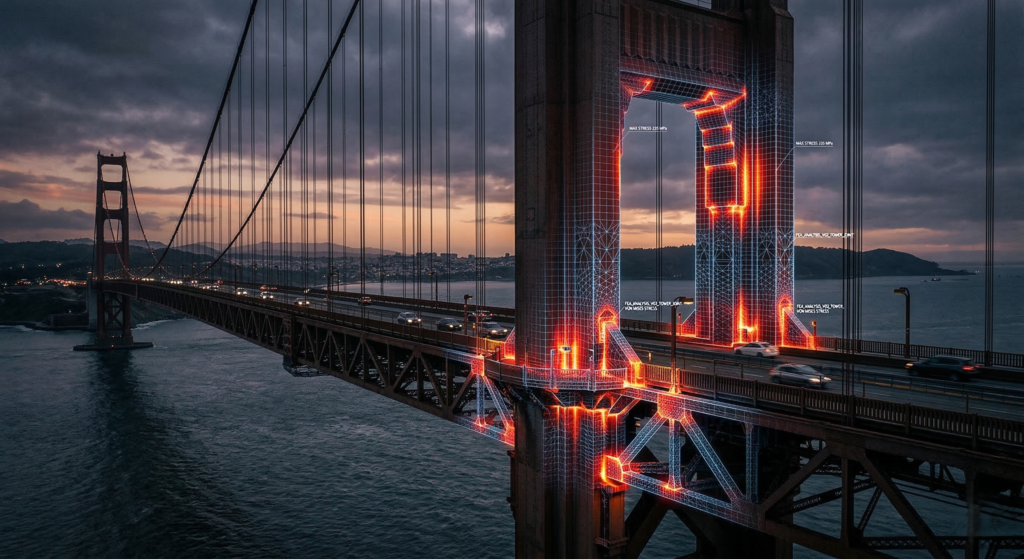
There is a dangerous phrase in engineering that has preceded some of the world’s greatest disasters: “It looks good enough on paper.”
For decades, “on paper” was all we had. We relied on the “Old Guard” method, a gruelling cycle of manual hand calculations, conservative safety factors, and the incredibly slow, incredibly expensive process of building physical prototypes just to break them. While this methodology gave us the steam engine and the Moon landing, it had a massive blind spot. It couldn’t account for the chaotic, non-linear realities of fluid turbulence or the microscopic stress concentrations hidden deep within a complex joint.
When those blind spots aren’t addressed, we encounter the Cost of Failure. It is a price tag that is rarely just financial. While a botched design can drain hundreds of millions of dollars from a project’s bottom line, the true cost is often measured in reputational ruin, the kind that ends firms and dissolves careers and, most tragically, in the loss of human life.
Today, the margin for error has shrunk as our ambitions have grown. We are building taller, lighter, and faster than ever before. In this high-stakes environment, Finite Element Analysis (FEA) and Computational Fluid Dynamics (CFD) are no longer “premium” add-ons or “extra” steps reserved for aerospace giants; they are an essential step to creating a high-performing, safe product.
By creating a high-fidelity digital twin of a bridge, a turbine, or a platform, we can subject a design to a thousand lifetimes of stress before a single gram of material is ever cast. In this article, we’re going to discuss three high-profile engineering failures where the “Cost of Failure” was astronomical, and show exactly how modern simulation would have identified the flaws before it was too late.
Case Study I: The $700 Million “Mesh Error” (Sleipner A)
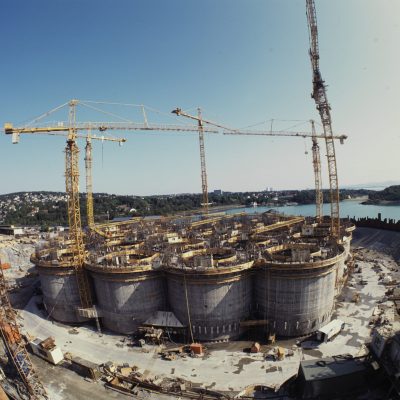
On August 23, 1991, the Gandsfjorden in Norway became the site of one of the most expensive engineering lessons in history. The Sleipner A offshore platform, a massive 82,000-tonne concrete structure designed to extract natural gas, was undergoing a routine ballast test. As the structure was lowered into the water, a loud bang echoed through the hulls. Within 18 minutes, the entire platform had vanished beneath the waves, leaving nothing but a massive oil slick and a seismic reading equivalent to a 3.0 magnitude earthquake.
The Technical Gap: When “Roughly Right” is Precisely Wrong
The investigation that followed uncovered a chilling technical oversight. The failure originated in the tri-cells, the triangular intersections where the massive cylindrical concrete tanks met. Under the immense hydrostatic pressure of the deep fjord, the concrete walls of these tri-cells sheared apart.
The engineering team had used Finite Element Analysis (FEA) to design the platform. However, they made a fatal assumption: they used a coarse mesh. In the world of FEA, “mesh” refers to the small geometric shapes (elements) that the computer uses to calculate stress. Because the elements in their model were too large and lacked detail at the critical joints, the simulation failed to capture the extreme stress concentrations. The result? The FEA model underestimated the shear stress by a staggering 47%.
The FEA Lesson: The Criticality of Mesh Convergence
The sinking of Sleipner A is the definitive cautionary tale for Mesh Convergence. In any simulation, as you make your mesh finer (smaller elements), your results become more accurate. A responsible engineer performs a convergence study, rerunning the simulation with increasingly smaller elements until the stress values stop changing significantly (as detailed in our article on FEA).
The Sleipner engineers relied on a “global” model that was too simplified to see the “local” disaster waiting in the corners of the tri-cells. If they had isolated those joints and applied a refined, high-density mesh, the “red zones” of failure would have been impossible to ignore.
The ROI: Simulation vs. Catastrophe
When we look at the numbers for this particular case study, the argument for high-fidelity simulation becomes undeniable.
| Item | Estimated Cost |
|---|---|
|
High-Fidelity FEA Study |
$10,000 – $50,000 |
|
Total Loss of Sleipner A |
$700,000,000 |
Case Study II: The Bridge That “Breathed” (Tacoma Narrows)
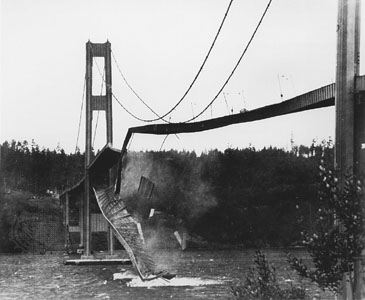
If Sleipner A was a failure of structural modelling, the Tacoma Narrows Bridge collapse of 1940 is the ultimate cautionary tale for fluid dynamics. Known colloquially as “Galloping Gertie,” the bridge didn’t just break; it twisted, undulated, and eventually tore itself apart in a 42 mph wind, a wind speed it was theoretically designed to withstand.
The Technical Gap: Static Math in a Dynamic World
At the time, bridge engineering focused almost entirely on static wind loads. Engineers calculated how much force a steady wind would push against the side of the structure, much like pushing against a wall. What they missed was the behaviour of the air as it moved around the bridge.
The bridge used solid plate girders for its supports. As wind hit these flat surfaces, it couldn’t flow smoothly. Instead, it created vortex shedding, swirling eddies of air that detached from the top and bottom of the girders at regular intervals. These vortices created alternating low-pressure zones that “tugged” on the bridge. When the frequency of that tugging matched the bridge’s natural frequency, it triggered aeroelastic flutter. The bridge wasn’t just being pushed; it was being driven like a swing on a playground.
The CFD Lesson: Seeing the Invisible with FSI
Today, we don’t have to guess how wind will interact with a structure. Computational Fluid Dynamics (CFD) allows us to visualise these “invisible” pressure differentials in high definition. Specifically, we use Fluid-Structure Interaction (FSI) to simulate how a moving fluid (the wind) deforms a solid object (the bridge) and how that deformation, in turn, changes the fluid flow.
A modern CFD transient analysis would have immediately flagged the “bluff body” design of the plate girders. Engineers would have seen the violent oscillating wake patterns on their monitors long before a single cable was spun. This data would have led to simple aerodynamic fixes, like adding fairings or using open trusses, that allow the wind to pass through rather than fighting it.
The RIO: Days of Computing vs. Decades of Rebuilding
The collapse of the Tacoma Narrows Bridge wasn’t just a loss of steel and concrete; it was a total loss of a vital transit artery and a massive blow to public confidence in engineering. In the 1940s, they lacked the tools to see the wind. Today, leaving those forces to “guesswork” is an engineering choice we simply don’t have to make.
| Metric | The Old Method | The Modern Method |
|---|---|---|
|
Time |
Years of “wait and see” |
3 – 5 days for a CFD simulation |
|
Design Fix |
Total demolition and rebuild |
Minor tweaks to CAD |
|
Result |
$6.4M loss (1940 USD) |
Optimised, stable structure |
Case Study III: The Deadly “On-the-Fly” Change (Hyatt Regency)
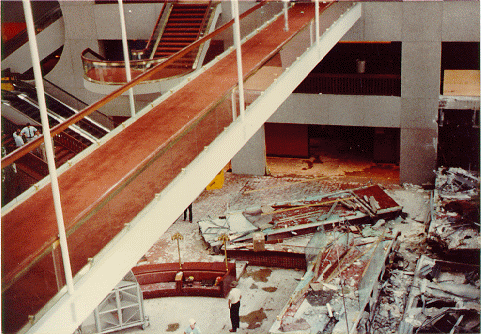
On July 17, 1981, a tea dance at the Hyatt Regency in Kansas City turned into a nightmare. Two suspended walkways, packed with guests, collapsed onto the crowded lobby below. It remains the deadliest non-intentional structural failure in U.S. history, claiming 114 lives. Unlike the previous cases, this wasn’t a failure of complex aerodynamics or deep-sea pressures; it was a failure of a simple connection point.
The Technical Gap: A Fatal Shift in the Load Path
The original design called for a single, long hanger rod to pass through the upper walkway and continue down to support the lower one. However, the fabricator found this difficult to manufacture and suggested a “small” change: using two separate rods.
The first rod would hang from the ceiling to the upper walkway, and a second rod would hang from the upper walkway down to the lower one. It seemed like a minor logistical tweak. In reality, it was catastrophic. By offsetting the rods, the upper walkway’s box beam was suddenly forced to carry the load of both walkways simultaneously. The stress on the nut and the beam was effectively doubled, far exceeding its ultimate capacity.
The FEA Lesson: The Power of Assembly Analysis
The Hyatt Regency tragedy is a haunting reminder that FEA isn’t just for analysing a single, isolated part; it’s for Assembly Analysis. In a modern engineering workflow, a designer doesn’t just look at a rod or a beam in a vacuum; they look at the system.
If this design change had been plugged into a simple Linear Static FEA model, the error would have been blindingly obvious. The software would have mapped the load path from the ceiling, through the upper connection, and down to the floor. The Von Mises stress plots at that specific box beam joint would have “glowed red,” showing a factor of safety well below 1.0. A five-minute simulation would have revealed what a team of experienced engineers missed during a cursory review of shop drawings.
The ROI: A Five-Minute Simulation vs. 114 Lives
The financial settlements following the Hyatt collapse exceeded $140 million (in 1980s dollars), and the firm’s engineers lost their licenses. But the true cost, the human one, is immeasurable. In an era of fast-tracked projects and “on-the-fly” manufacturing changes, FEA acts as the ultimate digital referee. It doesn’t care about convenience or deadlines; it only cares about the physics.
| Metric | Manual Review (1981) | Full-System FEA (Today) |
|---|---|---|
|
Analysis Focus |
Indivdual component checks |
Hollistic system design review |
|
Error detection |
Human error |
Automated hot spot detection |
|
Result |
Catastrophic oversight |
Immediate stress detection |
The “Simulation First” Mindset: Key Takeaways
If the history of engineering disasters teaches us anything, it’s that “guessing” is the most expensive luxury a firm can have. Shifting to a Simulation First workflow isn’t just about avoiding the evening news; it’s about fundamentally changing how we innovate. When FEA and CFD are integrated at the start of the design phase, rather than as a final “sanity check”, the technical and economic advantages are transformative.
Iterate at the Speed of Thought
In the “Old Guard” days, testing a new wing shape or a bridge truss meant weeks of fabrication and expensive wind tunnel time. If it failed, you went back to the drawing board and lost a month.
With modern simulation, you can iterate through 50 different design permutations in the time it takes to grab a coffee. This allows engineers to move beyond “will it break?” to “how can I make it lighter, stronger, and more efficient?” without risking a single dollar in material waste.
Finding the “Invisible” Danger
Most catastrophic failures aren’t caused by the obvious loads we design for. They are caused by non-intuitive failure modes—the “invisible” variables that human intuition often misses:
• Thermal Expansion: How does the structure warp when one side is in the sun, and the other is in the shade?
• Fatigue Life: Where will microscopic cracks form after 10,000 cycles of vibration?
• Resonance: Does the hum of a cooling fan match the natural frequency of the mounting bracket?
Simulation uncovers these hidden “gotchas” by visualising physical interactions that are impossible to see with the naked eye.
The Power of the Digital Twin
The value of a simulation doesn’t end when the product leaves the factory. By maintaining a high-fidelity model, a Digital Twin, of a physical asset, engineers can troubleshoot issues in real-time.
If a sensor on an offshore platform picks up an unexpected vibration, you don’t have to send a dive team down immediately. You can plug that real-world data back into your FEA model to see exactly how that vibration is affecting the internal stresses of the structure. It’s the difference between reactive maintenance and proactive prevention.
Conclusion: Moving From Hindsight to Foresight
We often look back at disasters like the Hyatt Regency or the Sleipner A platform with the clarity of 20/20 hindsight. It’s easy to point at a drawing or a mesh density and say, “There. That’s where it went wrong.” But the true challenge for the modern engineer isn’t just understanding why things broke in the past; it’s ensuring they don’t break in the future.
The New Standard of Care
In the 21st century, the definition of “due diligence” has shifted. Engineering is, at its core, a profession of public trust. When we design a bridge, an aircraft, or a medical device, we are making a silent promise that the physics have been vetted.
In an era where high-performance computing is accessible from a laptop, skipping a high-fidelity simulation isn’t “saving the client money” or “streamlining the schedule.” It is a gamble with the client’s capital and the public’s safety. When the tools to predict a 47% stress error or a harmonic vibration exist, choosing not to use them isn’t an oversight; it’s negligence.
Beyond the Software
Of course, FEA and CFD are not magic wands. As we saw with Sleipner A, a simulation is only as reliable as the engineer’s understanding of the underlying physics. The software provides the data, but the engineer provides the judgment.
The goal of a “Simulation First” mindset isn’t to replace human intuition, but to calibrate it. It allows us to fail safely in a virtual environment so we can succeed reliably in the physical one. It moves us from a culture of “fixing what broke” to a culture of “designing what lasts.”
The Final Word
If you take away one lesson from these billion-dollar craters and tragic structural failures, let it be this: The most expensive simulation is the one you didn’t run. The cost of a license, a cloud computing cluster, or a few extra days of analysis is a rounding error compared to the cost of a catastrophic failure. In the modern world, foresight isn’t a luxury; it’s the foundation of everything we build.